Leading an AI Product Transformation
Role
Lead Product Designer
Focus
AI strategy, Vision, System
Scope
Trains & Buses, Directions
Timeline
2025
The Opportunity
Transportation search was designed around predefined queries and fixed result formats. But travel decisions are rarely that simple: users compare options, evaluate trade-offs and need different information depending on where they are in their journey. Emerging AI capabilities created an opportunity to move beyond a fixed search experience toward one that could understand user intent and adapt how information was presented.
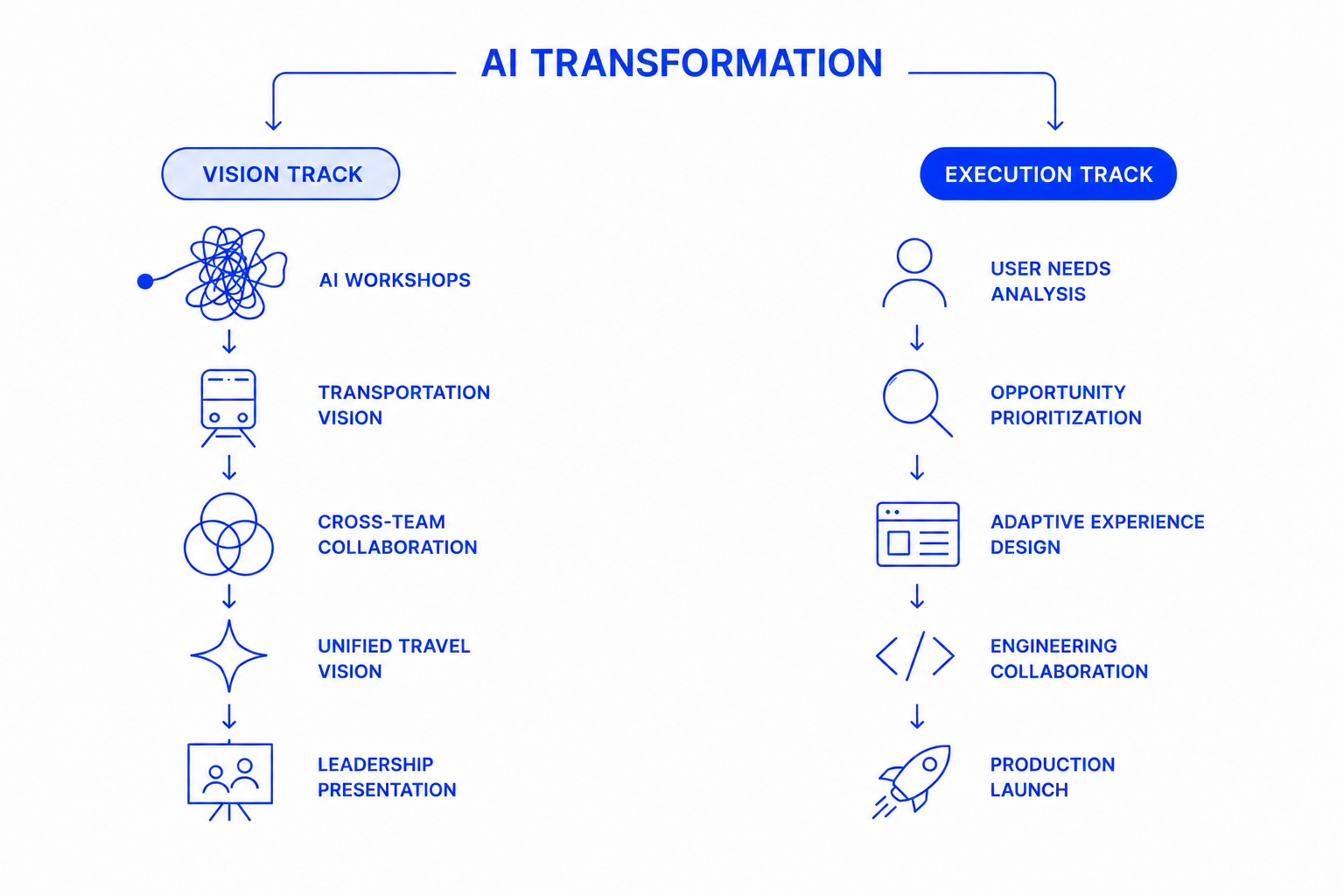
As the design lead for Transportation, I led two tracks in parallel: defining the long-term AI product direction while identifying opportunities we could bring into production immediately.
Two Tracks, One Transformation
I separated the work into two complementary tracks so that long-term exploration could progress without slowing near-term product delivery.
Vision Track
Define what AI could change
Facilitated vision workshops and collaborated across adjacent travel teams to define a shared AI direction beyond Transportation.
Execution Track
Find what we could ship now
Combined workshop insights with existing user research to identify an AI opportunity that could be delivered within the current product and design system.
Three decisions that made it shippable
1/ Reuse the existing system
Reuse before reinventing
I reused established design-system components instead of introducing AI-specific patterns, reducing implementation complexity and keeping the experience consistent with the existing product.
2/ Let presentation adapt to intent
The interface adapts—not the information.
I separated the underlying information from its presentation so the same data could support different user decisions without creating separate product experiences.
3/ Design within today's constraints
Design for what could ship now
Instead of waiting for the full North Star experience, I identified the smallest product shift that could demonstrate the value of adaptive AI within existing technical and design constraints.
Designing Adaptive Experiences
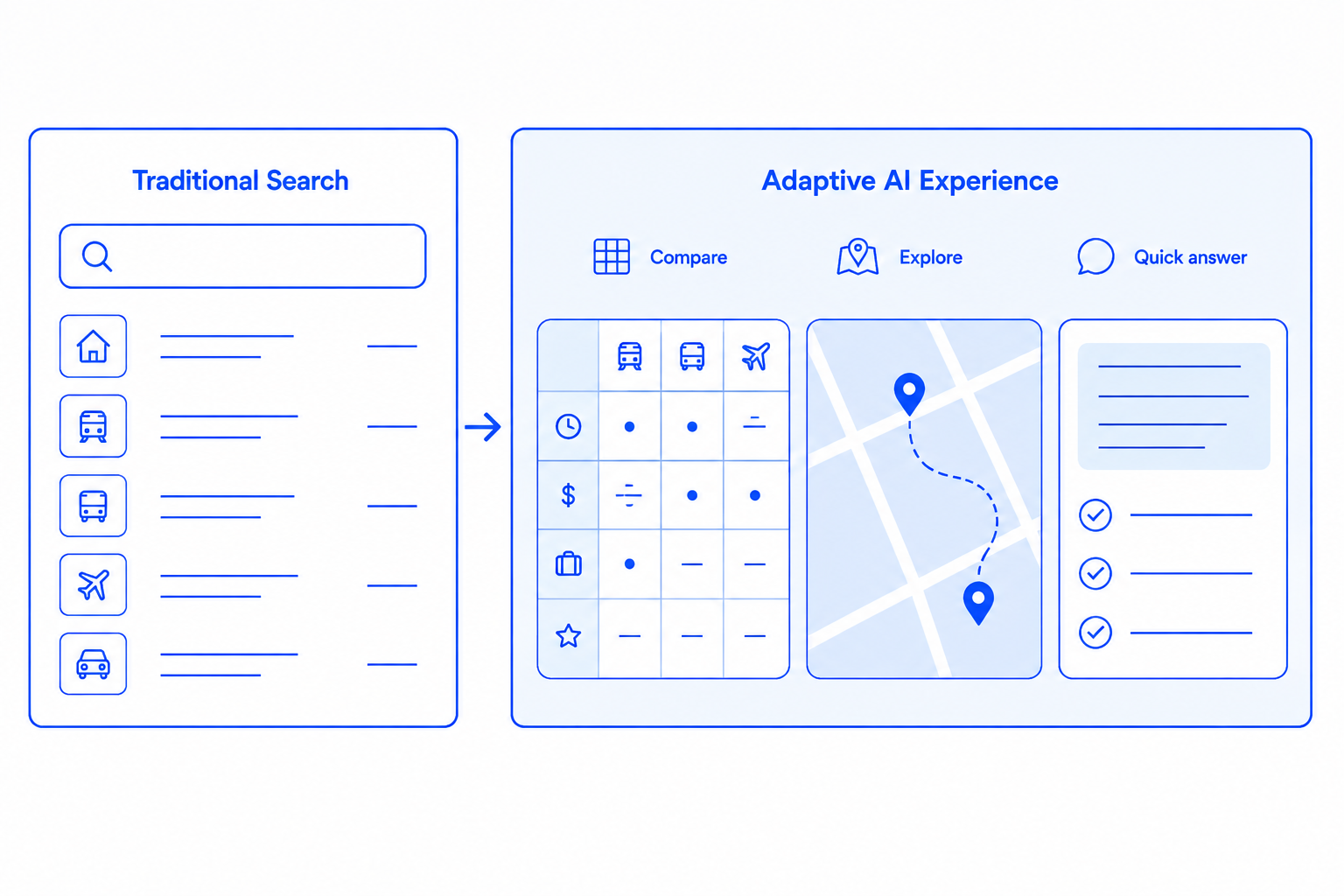
From fixed results to adaptive experiences
Instead of generating a new interface for every query, I designed a model where AI determines how existing product components should be composed based on user intent and context.
The same transportation information can support very different decisions. A user comparing options may benefit from a structured table, while another exploring a location may need a map, and someone seeking a direct answer may need only a concise summary.
Rather than creating AI-specific UI patterns, the experience dynamically composed existing design-system components. This made the interaction adaptive while keeping the underlying system familiar, scalable and feasible to ship.
Outcome
Product
Shipped an adaptive AI experience in production
Demonstrated how generative AI could change the presentation of transportation information without introducing a parallel UI system.
Strategy
Established a shared North Star beyond Transportation
Connected perspectives across travel domains into a common AI direction used in leadership discussions and future product exploration.
System
Created a scalable path for AI experiences
Reusing existing components showed that adaptive AI experiences could evolve within the established design system rather than requiring an entirely new interface framework.
Reflection
This project changed how I think about AI products. The biggest challenge wasn't designing AI interfaces. It was creating an organizational and product strategy that allowed long-term innovation and short-term execution to move forward together.